If your air conditioner is running but the house still feels warm, the cause is usually one of ten things, ranging from a five-minute fix to a repair that needs a licensed technician. The most common culprits are a clogged air filter, an incorrect thermostat setting, and a dirty condenser coil all things you can check yourself. Less common but more serious causes include low refrigerant, electrical failures, and an undersized system. This guide walks through all ten in the order you should actually check them, so you don’t call for service on something you could fix in the next ten minutes.
Why Is Your AC Running but Not Cooling?
An air conditioner that runs but doesn’t cool usually has a problem with airflow, heat transfer, or refrigerant circulation. Regular servicing from a trusted home maintenance company can help detect issues such as clogged air filters, dirty condenser coils, incorrect thermostat settings, frozen evaporator coils, or low refrigerant before they lead to poor cooling performance.
10 Reasons Your AC Isn’t Cooling
| Cause | Can You Fix It Yourself? | Typical Warning Sign | |
| 1 | Dirty air filter | Yes | Weak airflow, dust buildup |
| 2 | Wrong thermostat setting | Yes | Set to “Fan,” or wrong temp |
| 3 | Dirty condenser coil | Usually | AC runs constantly, warm air indoors |
| 4 | Low refrigerant/leak | No licensed tech required | Hissing sound, ice on lines |
| 5 | Frozen evaporator coil | Partially (shut off & thaw) | Visible ice, water pooling |
| 6 | Failing capacitor/electrical | No | Clicking sound, fan hums but won’t spin |
| 7 | Leaky or blocked ductwork | No (needs inspection) | Some rooms cool, others don’t |
| 8 | Undersized system | No (needs load calculation) | Runs nonstop, never hits setpoint |
| 9 | Heat pump stuck in heating mode | No (needs valve repair) | Warm air in “cool” mode, heat pump systems only |
| 10 | Aging system (12–15+ years) | No | Frequent repairs, declining efficiency |
Check these roughly in order: cheapest and simplest first, most invasive last. That’s also the order a technician typically diagnoses in.
1. Dirty or Clogged Air Filter
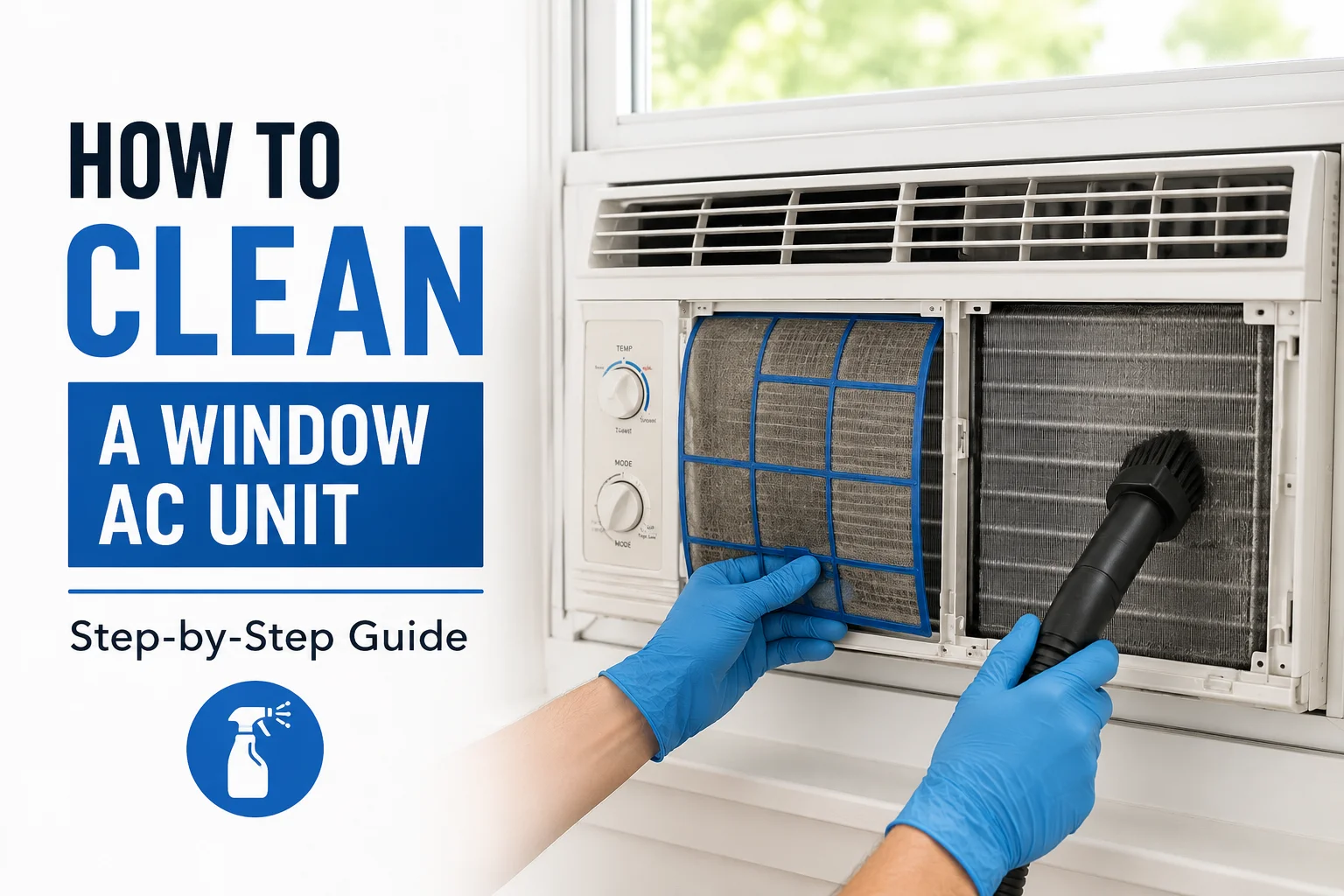
A dirty air filter is the single most common reason an AC runs but doesn’t cool, because it physically restricts the airflow your system needs to exchange heat. When the filter clogs with dust, pet hair, and debris, the evaporator coil doesn’t get enough air moving across it. Less air movement means less heat absorption, and in severe cases, the coil itself can ice over, which turns a five-minute fix into a multi-hour one.
Signs your filter is the problem:
- Airflow from vents feels noticeably weaker than usual
- Dust settles on surfaces faster than normal
- Energy bills have crept up without a change in usage
- The system short-cycles (turns on and off more frequently)
How to fix it: Locate the filter (usually in the indoor air handler or a return-air grille), pull it out, and hold it up to a light. If light doesn’t pass through cleanly, replace it. Standard 1-inch filters should be swapped every 30–60 days; thicker 4–5-inch media filters can last 6–12 months. Homes with pets or allergy sufferers should check monthly regardless of the filter’s rated lifespan.
2. Thermostat Set Incorrectly or Malfunctioning
If your thermostat is set to “Fan” instead of “Cool,” or a dead battery has caused it to lose its programming, your system will circulate air without ever cooling it. This is the fastest thing to rule out because it takes thirty seconds and requires no tools.
What to check:
- Mode is set to Cool, not Fan or Heat
- Target temperature is set at least 2–3°F below current room temperature
- Display is lit and responsive (dead batteries cause blank or frozen screens)
- Placement: A thermostat near a heat source (sunlight, a lamp, a kitchen) will misread room temperature and shut the system off early
How to fix it: Set the system to Cool, lower the setpoint, and replace batteries if the display is unresponsive. Wait 5–10 minutes; if vents blow noticeably colder air, this was the issue. Smart thermostats occasionally lose their schedule after a power outage, check the app or manual override if you have one.
3. Dirty or Blocked Outdoor Condenser Unit
The outdoor condenser unit’s job is to release the heat your AC pulls out of your home if its coil is caked in dirt, grass clippings, or surrounded by overgrown plants, that heat has nowhere to go, and the whole system loses efficiency. This is especially common in late summer after months of pollen, cut grass, and dust accumulation.
Signs of a blocked condenser:
- The unit runs almost continuously without the house cooling down
- The outdoor unit feels hot to the touch, or you can see visible debris on the fins
- Warm air blows from indoor vents despite the system running
How to fix it:
- Turn off power to the unit at the disconnect switch or breaker
- Clear at least 2 feet of space around the unit, remove plants, mulch, or stored items
- Gently rinse the fins from the inside out with a garden hose
- Let it dry fully before restoring power
4. Low Refrigerant (Refrigerant Leak)
Refrigerant doesn’t get “used up” like fuel; if your system is low, it means there’s a leak somewhere in the sealed line set, and that’s not a DIY fix. Low refrigerant reduces the system’s ability to absorb heat, so it runs longer, cools less, and can eventually damage the compressor, the single most expensive component in the system.
Signs of a refrigerant leak:
- AC takes noticeably longer to cool the house than it used to
- Hissing or bubbling sounds near the indoor or outdoor unit
- Ice forming on the refrigerant lines despite normal filter and airflow
- Higher electric bills from the system running longer to hit the setpoint
5. Frozen Evaporator Coil
A frozen evaporator coil is usually a symptom, not the root cause. It’s what happens when airflow is restricted (dirty filter) or refrigerant is low, and it means the system needs to be shut off before it causes further damage. Ice forms on the coil when its surface temperature drops below freezing, which then blocks airflow entirely and can cause water to pool or leak near the indoor unit.
Signs of a frozen coil:
- Visible ice on the copper refrigerant lines or the coil itself
- Water pooling under or near the indoor air handler
- The system runs but produces little to no cool air at all
What to do: Turn the system off completely (not just the thermostat; switch off cooling mode) and let it thaw naturally for 2–4 hours, or turn on just the fan to speed up thawing. Never try to chip or scrape the ice off; this can puncture the coil. Once thawed, check and replace the air filter, since that’s the most common trigger. If the coil freezes again within a day or two of resuming normal operation, the cause is very likely low refrigerant, and you’ll need a technician to check for leaks.
6. Failing Capacitor or Electrical Issue
The capacitor stores and releases the electrical charge that starts your compressor and fan motors. When it fails, the system often tries to start, fails, and shuts itself off within seconds. This is one of the most common repair calls in older systems, especially after a hot stretch of weather that puts extra strain on the motors, or following a power surge.
Signs of a capacitor or electrical problem:
- A distinct clicking or humming sound from the outdoor unit
- The outdoor fan doesn’t spin, or spins slowly, while the indoor fan runs normally
- The system shuts off within a few minutes of starting (“short cycling”)
- The unit doesn’t turn on at all despite the thermostat calling for cooling
Why this needs a professional: Capacitors hold an electrical charge even after power is disconnected, which makes them dangerous to handle without proper discharge tools and training. A licensed technician can test capacitance with a multimeter and replace it with usually a same-day fix, along with checking related components like contactors and relays that fail for similar reasons.
7. Leaky or Blocked Ductwork
If some rooms cool fine while others stay warm, the AC unit itself is often working correctly. The problem is cold air escaping through gaps in the ductwork before it reaches those rooms. This is especially common in ducts that run through unconditioned spaces like attics, crawlspaces, or garages, where joints can separate or insulation can degrade over time.
Signs of duct problems:
- Noticeable temperature difference between rooms, especially upper floors versus lower floors
- Rooms far from the air handler are consistently warmer
- Higher energy bills despite a well-maintained unit
- Visible gaps, disconnected sections, or crushed flex duct in accessible areas (attic, basement)
How to fix it: Basic checks, making sure all vents are open and not blocked by furniture or rugs, cost nothing. Beyond that, sealing and insulating ductwork requires a professional inspection with a duct blower test to measure air loss accurately; it’s not something you can diagnose from feel alone, since leaks are often in inaccessible sections.
8. Undersized AC for the Space
If your AC runs almost continuously during peak heat and the house never quite reaches the thermostat’s setpoint, the unit may simply be too small for the square footage it’s cooling. This is common in homes that added square footage (a finished attic, a sunroom, a home addition) without upgrading the AC’s capacity, or in homes where the original system was undersized from installation.
Signs your system is undersized:
- The unit runs nearly nonstop on hot days, but the house stays a few degrees above the setpoint
- Indoor humidity feels high even when the temperature is close to the target
- Rooms furthest from the unit or with more window exposure never quite cool down
How to fix it: This isn’t a repair; it’s a sizing issue. A qualified HVAC contractor performs a Manual J load calculation that accounts for square footage, insulation, window area, and local climate to determine the correct tonnage. Solutions range from adding a ductless mini-split to a problem room to upgrading the whole system’s capacity.
9. Heat Pump Stuck in Heating Mode
If your outdoor unit is a heat pump rather than a standard AC condenser, a stuck reversing valve can keep the system in heating mode even when the thermostat is set to cool, meaning you’ll get warm air blowing exactly when you want cold. Heat pumps use the same components as an AC in cooling mode, plus a reversing valve that switches the refrigerant flow direction for heating. When that valve sticks (common after long periods without switching, such as right at the seasonal changeover), the system stays in the wrong mode.
Signs of a stuck reversing valve:
- The system is a heat pump (not a standard AC), and only started struggling since the season changed
- Warm or lukewarm air blows despite the thermostat clearly set to Cool
- The issue appeared right around a heating-to-cooling seasonal switch
How to fix it: Try a full thermostat reset first, since some units simply need the mode command re-sent. If warm air persists in cooling mode, the reversing valve or its solenoid needs professional inspection; this is an internal refrigerant-circuit component and isn’t accessible or safe to repair without HVAC training.
10. Aging System Losing Efficiency
Even a well-maintained AC gradually loses cooling capacity after 12–15 years, as components like the compressor, blower motor, and coils wear down and at some point, repair costs stop making financial sense compared to replacement. Unlike the other nine causes, this isn’t a single fixable fault; it’s the cumulative effect of age on a mechanical system.
Signs your system’s age is the issue:
- Repairs have become more frequent over the past year or two
- The system uses R-22 refrigerant
- Energy bills have risen gradually even without a change in usage or local rates
- The unit is noticeably louder or less consistent than it used to be
What to do: A technician can assess remaining component life and give a repair-vs-replace recommendation. As a rule of thumb: if the unit is under 10 years old and a repair costs less than 30% of a full replacement, repairing usually makes sense; beyond that, replacement often costs less over a 5-year horizon once you factor in efficiency gains and reduced repair frequency.
Want better cooling and lower energy bills? Read our guide on how to set AC temperature for cooling.
Still Not Getting Cool Air?
If you have checked the common causes and your AC still isn’t cooling properly, the issue may require a professional inspection. Problems such as refrigerant leaks, electrical faults, or compressor issues are best diagnosed by experienced technicians. Professional AC repair services can identify the root cause, prevent further damage, and restore reliable, energy-efficient cooling.
FAQs
Why is my AC blowing air but it’s not cold?
This almost always points to either a thermostat set to “Fan” instead of “Cool,” a dirty air filter restricting airflow, or low refrigerant. Check the thermostat and filter first since both take under a minute to rule out.
What is the most common reason an AC is not cooling?
A dirty or clogged air filter is by far the most common cause. It restricts the airflow the system needs to absorb heat, and because filters are easy to forget, this single issue accounts for a large share of “AC not cooling” service calls, most of which resolve as soon as the filter is replaced.
Why is my AC still not cooling even after I cleaned it?
If you’ve already cleaned the filter and the outdoor condenser coil and the house still isn’t cooling, the problem has moved past basic maintenance and into territory that requires a technician, most likely low refrigerant from a leak, a failing capacitor, or ductwork losing cool air before it reaches the rooms. Cleaning fixes airflow-related causes; it can’t fix a refrigerant shortage or an electrical fault, since those aren’t dirt or debris problems.
Should I keep running my AC if it’s not cooling? No. If you notice ice on the coil, warm air, or unusual noises, turn the system off. Continuing to run it can cause a small problem (like a dirty filter) to damage the compressor, which is far more expensive to replace.
Can a power surge cause my AC to stop cooling? Yes. Surges from storms or grid fluctuations can damage the control board or trip a breaker, leaving the system running but non-functional. If problems started right after a storm, have the electrical components checked before assuming it’s a mechanical issue.
How long should an AC take to cool a house? Typically 1–3°F per hour under normal conditions. If it’s taking significantly longer, suspect airflow restriction (filter/coil) or low refrigerant rather than assuming the outdoor temperature alone is to blame.