
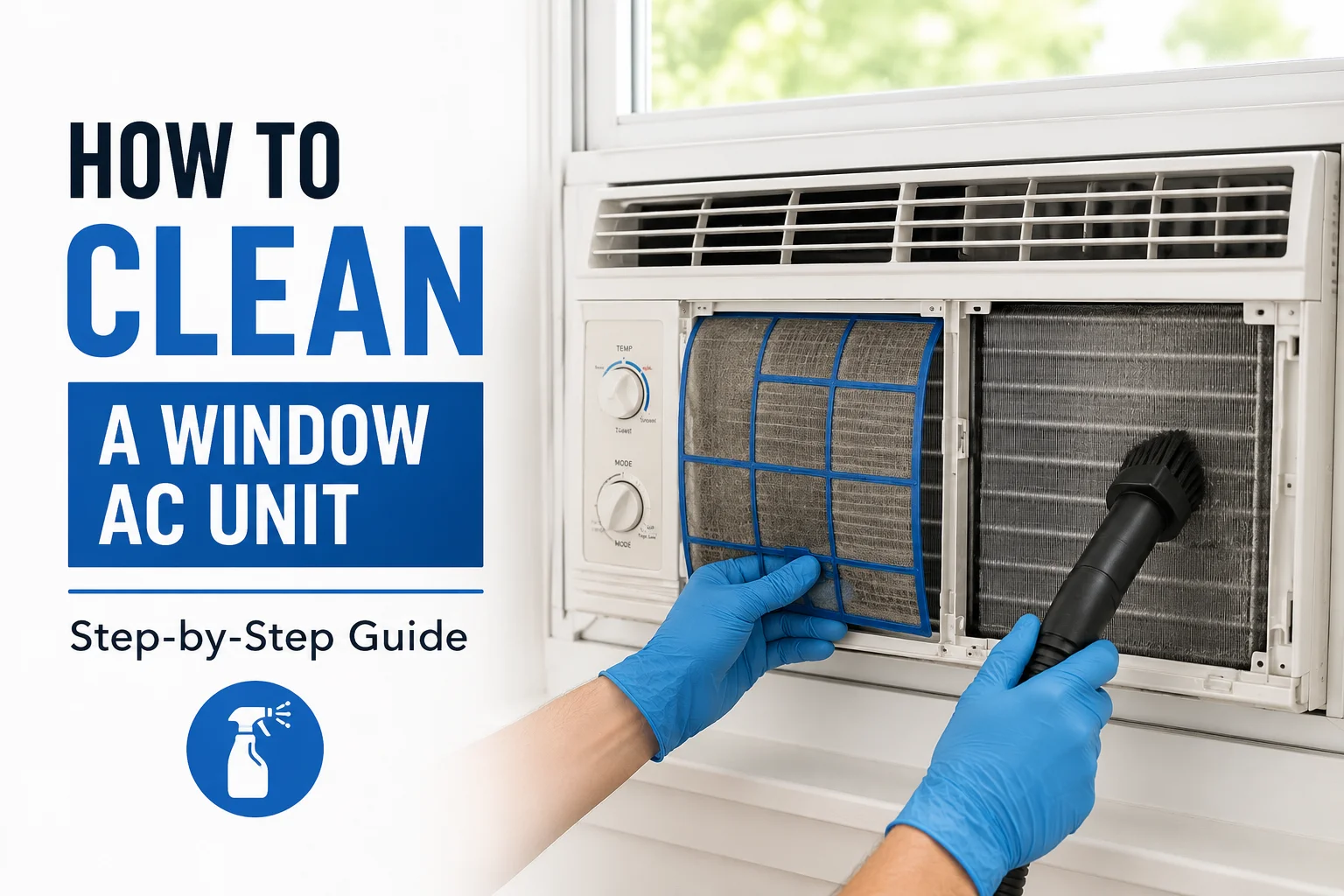
A window AC unit that hasn’t been cleaned in a season or two loses cooling power, drains more electricity, and often starts blowing a musty smell into the room. None of that comes from the unit wearing out. It comes from a clogged filter, dirty coils, and a drain pan that has turned into a small breeding ground for mold. Fixing all three takes under an hour and no special skills, only the right order of steps.
This guide covers the full process end to end: what to gather, how to clean the filter, coils, condenser, and drain pan safely, how often to repeat each task, and what to do when the job is bigger than a home cleaning can fix.
What You Need to Clean a Window AC Unit
Most of this list is already in a kitchen or garage. The two items worth buying if you don’t have them are a coil cleaner spray and a fin comb, since nothing else reaches between the aluminum fins the way those two tools do.
| Tool or Supply | Purpose |
| Screwdriver (Phillips and flathead) | Removes the front panel and screws holding the grille |
| Soft brush or vacuum brush attachment | Lifts loose dust from coils and fins without bending them |
| Coil cleaner spray | Foams into the coil fins and dissolves grease and dirt a brush can’t reach |
| Fin comb | Straightens bent aluminum fins so air can pass through evenly |
| Mild dish soap and warm water | Washes the removable filter |
| White vinegar | Sanitizes the drain pan and dissolves mineral and algae buildup |
| Spray bottle | Delivers a controlled, low-pressure rinse over the coils |
| Microfiber cloths | Wipes down the housing and drains excess moisture |
| Rubber gloves and safety glasses | Protect skin and eyes from coil cleaner chemicals |
A shop vacuum with a narrow nozzle attachment works better than a standard vacuum for the coil area, since the narrow tip gets between fins without pressing on them. If the filter is a disposable fiberglass type rather than a reusable mesh one, skip the washing step and replace it instead; washing a disposable filter breaks down its fibers and reduces its ability to trap particles.
How to Clean a Window AC Unit, Step by Step
1. Cut power and let the capacitor discharge
Unplug the unit at the wall, or shut off the breaker if it’s hardwired. Window units contain a capacitor that stores an electrical charge even after the power is cut, so wait a full five minutes before opening the housing. This is the step most home cleaning guides skip, and it’s the one that actually matters for safety.
2. Remove the front panel and pull the filter
Most panels either snap off by hand or come free after removing two to three screws along the edge. Set screws aside in a small dish so they don’t disappear into the carpet. The filter sits directly behind the panel, usually held in place by a slide track or a small tab.
3. Wash or replace the filter
For a reusable mesh filter, submerge it in warm water with a small amount of mild dish soap and work the suds through with your fingers or a soft brush. Rinse until the water runs clear, then set it somewhere flat to air dry completely. A filter that goes back in still damp attracts dust immediately and becomes a mold surface within days. For a disposable filter, replace it outright rather than washing it.
4. Vacuum the evaporator coils and fins
With the filter out, the evaporator coils are exposed. Run the vacuum’s brush attachment along the fins in the same direction they run, typically vertical, rather than side to side. Moving against the grain of the fins is how they get bent, and bent fins block airflow permanently until straightened.
5. Apply coil cleaner and rinse
Spray coil cleaner evenly across the coil surface and let it sit for 10 to 15 minutes. It will foam, then break down as it lifts embedded dirt, and the residue drips into the drain pan below. Rinse with a spray bottle of clean water, aiming from the inside toward the outside edge so debris moves away from the unit rather than deeper into it. Keep any spray away from the motor housing and wiring; laying a dry cloth over those areas first adds a margin of safety.
6. Clean the condenser coils at the back
The condenser side faces outdoors and collects windblown debris such as pollen, grass clippings, and dust. If the back of the unit is reachable without removing it from the window, vacuum it the same way as the evaporator side, then apply coil cleaner if it’s heavily soiled.
7. Clear and sanitize the drain pan
The drain pan at the bottom collects condensation, and it’s the single most common source of the musty smell people associate with window units. Wipe out standing water and visible debris, then pour a mixture of equal parts water and white vinegar into the pan and let it sit for a few minutes before wiping again. Check that the drain hole or hose isn’t blocked; a thin wire or pipe cleaner clears most clogs.
8. Dry completely, then reassemble
Every part needs to be fully dry before it goes back together, since trapped moisture is what feeds mold growth between cleanings. Reattach the filter, snap the panel back into place, and plug the unit back in. Run it for a few minutes and listen for anything that sounds different from before, and confirm water is dripping from the outdoor drain, which confirms the condensate system is working.
How to Clean Window AC Coils
Coils get their own section here because they’re the part most cleaning attempts get wrong. The evaporator coil absorbs heat from indoor air, and the condenser coil releases that heat outdoors. When either one is coated in a layer of dust, it can’t transfer heat efficiently, so the compressor runs longer to reach the same temperature. A coil running at even a 10 to 15 percent dirt coverage can raise energy use noticeably over a full cooling season.
Fin combs come in different tooth spacings, usually measured in fins per inch. Using a comb with the wrong spacing for your unit can bend fins rather than straighten them, so check the fin count on the coil, roughly by counting how many fins sit within a one inch strip, before buying one. Insert the comb parallel to the fin direction and pull it through in a single smooth motion instead of sawing back and forth.
Avoid using a kitchen knife or similar sharp tool to straighten fins. It’s a common shortcut, but a blade concentrates pressure on one point of a very thin piece of aluminum and tends to puncture rather than bend it.
How to Clean a Window AC Without Removing It
Most of the interior cleaning, including the filter, evaporator coils, and drain pan, can be done without taking the unit out of the window. Access the front panel from inside the room, remove the filter, and work through the vacuum and coil-cleaner steps as described above.
The one part that’s genuinely harder to reach without removal is the condenser coil on the outdoor-facing side. If the back of the unit sits flush against the window frame with no gap to work through, a full removal gives better access for that side. For units mounted with a support bracket that allows a few inches of clearance at the back, a flexible vacuum extension can often reach in without pulling the unit.
How to Remove Mold From a Window AC Unit
Light mold, the kind that shows up as gray or greenish film on the filter or drain pan, responds well to a solution of equal parts water and white vinegar applied directly and left for several minutes before wiping. Vinegar’s acidity breaks down mold’s cell structure without the fumes of bleach in an enclosed space.
For mold on hard plastic or metal surfaces that vinegar doesn’t fully clear, a diluted bleach solution, one part bleach to ten parts water, works as a stronger option, but should only be used on non-porous parts and rinsed thoroughly afterward. Never mix bleach and vinegar; combining the two produces chlorine gas.
Black mold that has spread across a large area of the interior, particularly around the blower wheel or deep inside the housing, is where a home cleaning approach should stop. Disturbing widespread black mold without containment can push spores into the room’s air rather than remove them, which is a job for a professional with the right equipment.
Can You Pressure Wash a Window AC Unit?
No. Pressure washers, even on a low setting, generate more force than the aluminum fins on a coil can handle, and a bent fin blocks airflow the same way a clogged one does. A garden hose on a gentle spray setting, or the spray-bottle method described in the step-by-step section, delivers enough cleaning force without the risk. If a unit is extremely dirty and a hose feels necessary, aim it at the outdoor housing exterior only, never directly at the coil fins.
How Often to Clean a Window AC Unit
| Component | Recommended Frequency |
| Filter | Every 2 to 4 weeks during active cooling season |
| Evaporator and condenser coils | Twice a year, at the start and end of cooling season |
| Drain pan | Monthly during humid weather |
| Full deep clean | Once a year, ideally before the first heavy-use week |
Homes with pets, nearby construction, or high pollen exposure should clean the filter closer to every two weeks rather than monthly, since the filter is what protects the coils from most of the buildup in the first place.
Signs Your Window AC Needs Cleaning Now
- Cooling feels weaker than it did a few weeks ago, even though the thermostat setting hasn’t changed
- A musty or sour smell comes through the vents when the unit first turns on
- Visible dust has collected on the front grille or is blowing out with the airflow
- Water is pooling on the floor or windowsill instead of draining outside
- The unit is louder than usual, which can mean a fan blade is catching on debris or a bent fin
Any one of these on its own is a reasonable prompt to clean the unit rather than waiting for the next scheduled maintenance window.
If cooling still feels weak after cleaning, the problem may not be dirt at all, see why AC isn’t cooling properly for refrigerant, thermostat, and compressor issues.
Window AC Maintenance Tips
A slight backward tilt, roughly a quarter inch lower on the outdoor side, helps condensation drain outside instead of pooling inside the unit. Check this tilt once a season, since brackets can shift slightly over time.
Keep the outdoor-facing side clear of leaves, grass clippings, and anything that can get pulled into the condenser fan. During storage months, cover the unit and keep it somewhere dry rather than leaving it in the window, since a covered but still-installed unit can trap humidity against the coils over winter.
Keeping a simple log of cleaning dates makes it easier to notice when performance starts to slip relative to the last cleaning and it pairs well with a broader routine, since window AC upkeep is just one part of seasonal home maintenance services.
Common Mistakes That Damage Window AC Units
- Vacuuming or combing against the direction of the fins, which bends them rather than clearing them
- Reassembling the unit while the filter or coils are still damp
- Using a pressure washer or high-force hose spray directly on the coils
- Mixing bleach and vinegar in the same cleaning session
- Skipping the capacitor discharge wait time before opening the housing
- Ignoring the drain pan because it’s less visible than the filter or coils
When to Call a Professional
Basic filter, coil, and drain pan cleaning is manageable for most people with an hour and the supplies listed above. A few situations call for more than a home cleaning:
- Mold that has spread across a wide interior area rather than staying on the filter or drain pan surface
- Cleaning the blower wheel or other internal components that require partial disassembly beyond the front panel
- Any sparking, burning smell, or breaker tripping when the unit runs, which points to an electrical issue rather than a dirt issue
- Multiple window units in one home, where a professional servicing all of them in one visit is often faster and more cost-effective than tackling each separately
- A unit still under warranty that specifies professional maintenance to keep coverage valid
Basic filter, coil, and drain pan cleaning is manageable for most people with an hour and the supplies listed above. A few situations call for more than a home cleaning; that’s when it’s worth contacting an AC repair and maintenance company.
FAQs
How do I know if my window AC filter needs cleaning?
Hold the filter up to a light source; if light doesn’t pass through evenly across the mesh, it’s due for a wash. A visibly gray or matted filter is also an easy visual cue, and reduced airflow from the vents is the performance-side signal.
What happens if I never clean my window AC filter?
Airflow drops, the unit works harder to reach the same temperature, and energy use climbs. Left long enough, the reduced airflow can cause the evaporator coil to ice over, which can damage the compressor and turn a simple cleaning task into a repair bill.
Is vinegar or bleach better for cleaning a window AC unit?
Vinegar handles light mold and everyday sanitizing without strong fumes, making it the better default for routine cleaning. A diluted bleach solution is more effective against stubborn or established mold on hard, non-porous surfaces, but the two should never be combined and bleach needs a well-ventilated space.
Why does my window AC still smell musty after I cleaned it?
A lingering smell after a standard cleaning usually means mold is present somewhere the routine steps didn’t reach, most often inside the drain pan below the visible surface or deeper on the evaporator coil behind the front fins. That level of access usually requires partial disassembly.
Can I clean a window AC unit myself, or does it need a professional?
The filter, coils, and drain pan are all reasonable for a homeowner to clean with basic tools. Internal component access, extensive mold, or any electrical warning signs are the point where professional service is the safer option.
How do I clean a window AC unit filter?
Remove the front panel, slide out the filter, rinse it in warm water with mild dish soap, and let it air dry fully before reinstalling. Replace it instead of washing if it’s a thin disposable filter.
How do I clean a window AC unit without removing it?
Pop off the front panel, pull the filter, vacuum and coil-clean the evaporator coils, rinse lightly, and clear the drain pan, all doable from inside the room. Only the outdoor condenser coil is harder to reach this way.